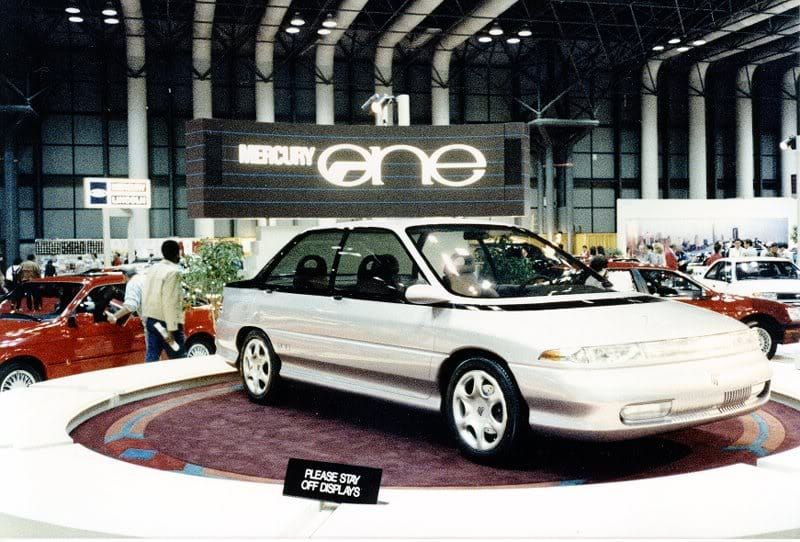
Mercury Concept One
Weird Car of the Day #38: 1989 Mercury Concept One

Often, there’s no happy ending for efficiency-driven design.
With concept cars, creativity and execution fight with desire and market forces to bubble up fleeting, one-off glimpses of a possible future, until reality bursts in and sends it all to the crusher.
Some concepts are so beloved they may come around twice as poster-worthy reimaginings, decades after first being shown (Hyundai N Vision 74, for example). Concepts can inspire tens of thousands of words across magazines, blogs, and social media.
With that in mind, presenting the 1989 Mercury Concept One: complete with three low-resolution photos and three lines of text. ;)
I promise there’s a point to this subtly revised Mercury Tracer sedan (itself a subtly revised Mazda 323 sedan). Actually, two.
First point: how subtle and simple good design can be. Next to the production versions of this car, it’s obvious where the Concept One’s bodywork differs and places more emphasis on aerodynamics.
Second point: how subtle and simple good design can be completely lost to time precisely because we are dumb apes who have a propensity to act contrary to our own best interests.

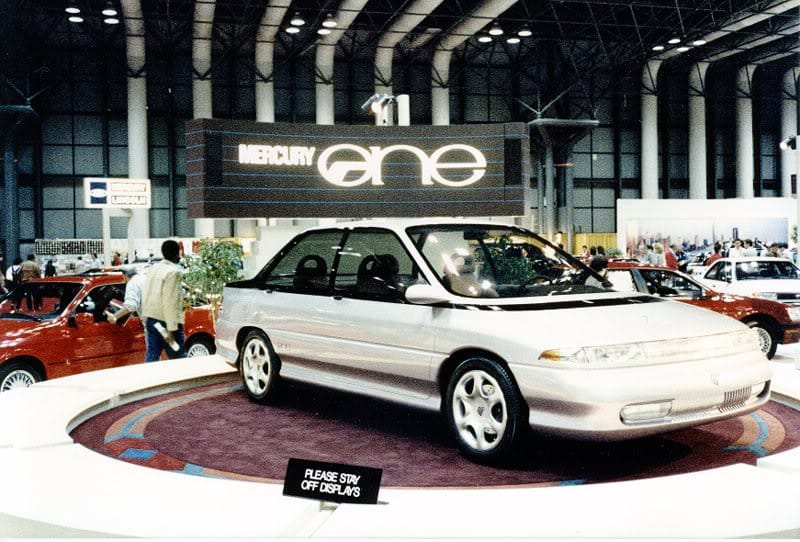
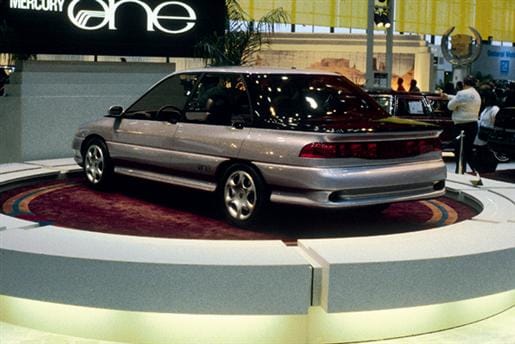
Mercury Concept One • via Chicago Auto Show

The three sentences written online, thanks to the (fantastic) archive of Chicago Auto Show concept cars maintained by the show, are:
- Ford and Mazda combined talents and developed the fiberglass Mercury One compact car concept.
- Outstanding aerodynamics was achieved by the flush glass and smoothly integrated body panels.
- The Mercury One indicated the design philosophy of future Mercury Tracer and Ford Escort.
One, simple enough. I haven’t yet found information on who styled it or where the kit was built, but at that time it could have ended up at U.S. studios in Detroit, L.A., or at a 3rd party builder under contract. The key here are the fiberglass panels, which (at the economies of scale needed for a small car) might have resulted in lower-cost repairs and better resilience from minor damage. With roof pillars that thin, after a major crash next of kin will be pleased they sent undertakers instead of pricey EMTs and hospital-bound life supports.
Two, “Outstanding aerodynamics was achieved…” where’s the proof, FoMoCo? If you’ve read Julian Edgar’s recent book on road car aerodynamics, you’ll realize how fast and simple it would have been to do basic measurements and tuft testing in order to validate that the glass and body panels were flush in all of the right places.
Three, a common trope: automakers making up the science after they’ve committed an idea to metal. I’d say the design philosophy came first — which shade of lipstick looks best on a Mazda 323 — later, how to give the car flush glass and shapely bodywork.


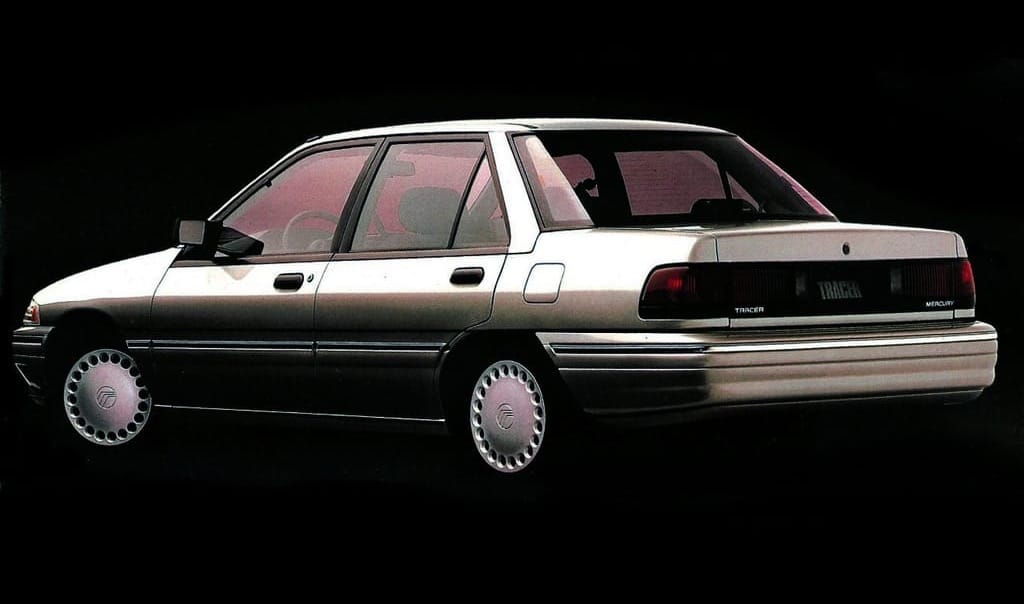



The differences in the Mercury Concept One don't immediately jump out until you put it next to the Mazda 323 and its sister cars.
Outside of concept cars, this password-worthy idea of “flu5h-bodyw0rk-Everywher3” hasn’t been explored much, and I think that’s a shame.
There are thousands of two-bit bodykit suppliers out there making millions of dollars by happily dropshipping crap like barn door spoilers, stick-on overfenders, and restyled intake grilles halfway around the world so that a nitwit in North America can further reduce the performance of his Chevrolet Camaro V6 Convertible.
In contrast, where are the 3-5 companies willing to make thousands of dollars on ultra-streamlined aftermarket parts after pouring (potentially) millions into R&D?
Painfully, because that’s assumed to be a manufacturer’s job. Modifications wouldn’t be cheap, and it’d take a marketing genius to convince customers that money spent chasing 2-5% improvements on economy, forever, was a better spend than on the (minimum) 5% in losses from cosmetic modification or worse, a roof rack and cargo.
Better aero isn’t getting anyone to work faster, right?
 michael banovsky
It’s one of those items best applied across entire industries so that the most effective improvements come at the time of purchase and are therefore seen as normal. An investment that pays off over time — thankfully, a desire for delayed gratification is a common trait of our culture in 2024.
I may still be drawn to the look, performance benefits, and long-term savings aero mods are proven to deliver, but I can’t expect you to feel the same.
Earlier I wrote, “…subtle and simple good design can be completely lost to time precisely because we are dumb apes who have a propensity to act contrary to our own best interests.”
Or — asked earnestly while folded into the third row of a crossover SUV — do we act against our best interests? Maybe every bloated make, model, and tank-like trend is exactly where it needs to be in the car market, said with a callous paucity borrowed from the “everything happens for a reason” crowd.
Back to the Mercury(-AMG) Concept One, I think its silky smoothness is handsome and, like the most effective skin care routines, an absence of wrinkles makes it appear younger than it really is.
I began by saying not all stories have happy endings, and that’s true here also; Concept One has been either lost to time or crushed. So much for that.
If you truly want a sleek and efficient road car, consider the notion it’s up to you to make it yourself. In the pursuit of truth, I can think of worse endings than this One.
 michael banovsky